
How our earliest relationships may shape our feelings about money
Introduction
Let me start with something that might surprise you.
If you have ever been told you are too anxious, too sensitive, too vigilant, or simply too much, there is a reasonable chance that throughout most of human history, those same qualities would have been considered genuine strengths. The nervous system patterns that can feel like liabilities in modern life were once real survival advantages. But we will come back to that. For now, the point is simply this: you are not broken. You may be carrying a very old, and once very useful, blueprint.
This blog is about where that blueprint comes from, how our earliest experiences become money stories, and what becomes possible when we finally recognize it for what it is.
Not everybody begins life from the same emotional and biological foundation. Some people grow up within environments of relative safety, consistency, and support. Others adapt to chronic stress, unpredictability, emotional absence, or rupture. Over time, those experiences appear to shape the nervous system, our relationship to uncertainty, and ultimately how we experience both life and money.
I want to be clear before we go further. Hardship, grief, and stress are part of being human. They are not evidence that something is wrong with us. The goal of exploring this is not to reduce anyone to a label, but to create compassion, awareness, and choice. Because alongside hopelessness there can still be hope, meaning, awe, profound love for ourselves and others, and moments that remind us we matter deeply.
Knowledge is not a ceiling. It is a door. Through greater awareness, we can begin to move away from shame and survival and toward deeper understanding, healing, belonging, and connection, both to ourselves and to one another.
My heart is in this work because I have seen — in my own life and in the lives of people I work with — how much genuine transformation remains possible, even after generations of survival-based patterning.
We will move through neuroscience, attachment theory, and an honest personal reflection. We will visit a client whose story might feel familiar. And we will end somewhere that, I believe, matters deeply: not just understanding where these patterns come from, but beginning to sense that they do not have to stay with us.
Where It All Began
My first child came into the world when I was twenty-one. He was what people often call an easy child: quiet, compliant, independent. Because he did not push back strongly, I did not have to confront myself. I continued moving through life the same way I always had: performing competence externally while remaining largely disconnected from my own internal world.
Then my daughter arrived, and something changed.
She felt everything intensely. She pushed back. She mirrored emotional realities I had spent years avoiding. My instinct was to tighten control, become stricter, manage harder, until eventually something inside me said stop.
I remember realizing with painful clarity that I was no longer truly responding to my daughter. I was responding to my own unresolved conditioning being reflected back at me. My daughter was not the problem. She was the mirror.
That realization became the beginning of a much deeper journey: into the work of Dr. Daniel Siegel, attachment theory, developmental neuroscience, and ultimately the work that now sits at the heart of everything I do with clients.Because the same systems that shape a child’s ability to feel safe, regulated, and connected appear to profoundly influence how an adult later relates to uncertainty, achievement, risk, money, and what is enough.
The Unconscious Is Already Running the Show
“Until we make the unconscious conscious, it will direct our lives and we will call it fate.”
— Carl Jung
Jung wrote this before neuroscience could map stress pathways or attachment systems, yet the insight remains remarkably accurate. Much of human behaviour operates outside conscious awareness. We experience the outputs: anxiety, hypervigilance, shame, compulsive striving, avoidance, emotional shutdown, overwork. We often mistake those patterns for personality.
But many of those patterns were shaped long before we had language for them.
In my blog about spiritual wealth, I wrote that money often becomes a surrogate for safety, belonging, control, and connection. What I want to explore now is why — not simply emotionally, but biologically. Because the nervous system learns before the mind does. We will meet Megan shortly, and her story will make this concrete. But first, let’s look at the ground beneath it. The place where many of our money stories begin.
We Are Born Unfinished — On Purpose
Human beings are born neurologically unfinished.
From an evolutionary perspective, nature never intended us to develop in isolation. Compared to many mammals, humans arrive extraordinarily dependent. If our brains fully matured in utero, our heads would simply be too large to survive childbirth. Evolution solved this by shifting much of our neurological development outside the womb and into the relationship itself.
We are born unfinished, and we complete ourselves in connection.
Before language develops, the nervous system is already learning through thousands of moments of touch, attunement, soothing, eye contact, and emotional presence. The developing brain is constructing an internal map of reality:
Is the world safe? Are people predictable? Will someone come when distress arises? Can vulnerability exist without danger?
When those experiences occur more often than not, the nervous system gradually organizes around safety, flexibility, and trust.
But when environments become chronically overwhelming, emotionally inconsistent, frightening, neglectful, or unstable, the nervous system adapts differently. It becomes increasingly vigilant, self-protective, and oriented toward anticipating threat and maintaining control. Over time, these adaptations may contribute to what is called insecure attachment: patterns of relating that develop when connection and safety feel inconsistent or uncertain
This is especially significant during childhood because the prefrontal cortex — the region involved in emotional regulation, reflection, impulse control, and long-term planning — continues developing well into our third decade of life. Chronic stress appears to influence how these neural pathways wire over time, orienting the brain more toward survival and threat detection than toward reflection and flexibility.
Recent research examining more than 26,000 Adult Attachment Interviews found that roughly half of adults are classified as securely attached, while the other half show varying degrees of attachment insecurity or unresolved trauma.
What makes a critical difference is whether stress occurs in the presence of safe, attuned connection. Oxytocin, sometimes called the bonding hormone, appears to help buffer the effects of chronic stress when that connection is present. When it is not, the stress response system may remain more chronically activated over time. In other words, the seeds planted earliest in life are not only emotional. They may also be biologically shaped through our social environment.
Importantly, this is not pathology, it is adaptation.
Adversity Is More Common Than We Realize
Research on Adverse Childhood Experiences (ACE), examining early adversity such as neglect, chronic stress, household instability, emotional absence, or growing up around unpredictability, demonstrates these patterns are far more common than many people realize. Fully two-thirds of adults report at least one ACE, with many reporting more than one.
What I find especially important within this research is the distinction between threat and deprivation. While overt adversity profoundly shapes development, emotional neglect, inconsistent attunement, and the absence of emotional safety may be equally, and sometimes more, influential in shaping the neural systems that later govern how individuals navigate uncertainty, relationships, and financial decision-making.
Yet it is important to approach this carefully. Adversity itself is not abnormal. Stress, grief, rupture, disappointment, and hardship are inseparable from human life. Manageable stress, when buffered by sufficient support and connection, may actually strengthen resilience over time — a phenomenon sometimes referred to as the steeling effect. Too much overwhelming adversity without sufficient support can dysregulate the nervous system and narrow its capacity for flexibility. But too little challenge can leave the nervous system equally unprepared for the inevitable ruptures of adult life.
Some children arrive with nervous systems that are naturally more sensitive, more reactive, or more easily overwhelmed. They may require more co-regulation, reassurance, and attuned support to feel safe and connected. At the same time, many parents are navigating significant pressures of their own, including stress, illness, financial strain, caregiving responsibilities, or unresolved challenges from earlier in life. As a result, chronic disruptions in connection can emerge in countless ways, including within families that are deeply loving and doing their best.
A Chance for Repair
I have seen this play out in my own home. When my daughter gets stuck in a difficult moment, she can sometimes ruminate for days if I do not gently help redirect the loop. What interrupts it is rarely a solution. It is a hug. A moment of feeling safe, seen, and connected.
Once that safety is restored, there is space to gently reframe what happened and help her find meaning in it. Through repeated experiences of being soothed by another, children gradually internalize that capacity and eventually learn to offer it to themselves.
The compassion we receive becomes the compassion we carry forward.
I have not always responded that way with her. Early on, I often became overwhelmed myself before I understood what regulation even was. I had to learn it before I could help teach it to her. That has also meant repairing parts of our connection and rebuilding trust along the way. But I have come to see that this, too, is part of the process.
I see this same dynamic show up with clients. When someone arrives carrying shame around their financial behaviours, maybe decades of overspending, avoidance, or chronic anxiety around money, the first thing that happens is rarely insight. It is rumination. They cycle through the history of their mistakes, losing sight of the resilience and strength those same experiences forged in them.
In those moments, my role as a financial coach is to hold the space briefly and then gently redirect the loop. Not by dismissing what is being said, but by finding the right moment to reflect back what I have heard in a way that makes the client feel understood. That reflection alone often creates a small pause. And in that pause, a reframe becomes possible. Something the client has not yet heard about their own story. Not a correction, but a different angle on the same experience, one that includes their strength alongside their struggle.
Our wounds may not begin with us. But awareness gives us the opportunity to change how they affect us.
Meet Megan: a money story
EDITOR NOTE: Megan is a composite character developed in collaboration with Joy Slabaugh, CFP and licensed therapist. She represents patterns that appear again and again in financial therapy work.
Megan is thirty-eight. By most external measures, she has done extremely well. Strong career. Significant savings. A relationship moving toward marriage.
What people do not see is what it costs her internally.
Every time she spends money on herself, shame follows. She keeps most of her savings in cash because financial systems feel emotionally unsafe and unpredictable. Despite being financially secure by most objective measures, she does not actually feel secure.
When her partner brings up shared financial planning, joint accounts, or long-term integration, she freezes. The issue is not mathematics. It is trust.
When asked what money means to her, she answers almost immediately:
“Safety. Security. Independence. I think safety is really about trust. Trusting that I won’t lose everything overnight.”
That is not a financial problem. It is an attachment wound wearing a financial costume.
Where the Story Began
Her financial coach invited her to complete a money genogram — a family map tracing the meanings and patterns around money across generations. What emerged surprised even Megan.
A family history shaped by scarcity, instability, and survival. Generations who had lived through displacement and uncertainty. A mother who held everything together alone, for whom self-reliance was not a choice but a necessity. The message that passed through the household — not in words, but in the emotional tone of daily life — was unmistakable: you can only count on yourself, and there is never quite enough.
Megan had never thought of these as beliefs. They were lived-in truths. They felt like facts.
The people who came before Megan planted her garden before she had any say in it. They chose the seeds from what they knew: survival, vigilance, and self-reliance. And the garden grew. It kept her alive. That matters.
The Money Scripts She Inherited
The concept of money scripts was developed by financial psychologists Brad Klontz and Ted Klontz, and financial therapist Rick Kahler, whose foundational research identified these as unconscious beliefs about money formed early in life and carried over into adulthood.
Here are some of Megan’s:
- Money is the only thing I can truly count on. Relationships leave. Jobs end. A savings account stays where you put it.
- Sharing finances means losing control. And losing control means losing safety.
- Spending on myself is selfish. There was never enough.
- If I stop watching, it will disappear.
None of these were conscious decisions. They were conclusions a small body reached in a difficult environment, and then carried faithfully into adulthood, into a career, into a relationship with a partner who could not understand why the door to shared finances kept closing. Megan is not broken. She is living out a story she never chose. But for the first time, she has the chance to walk back into that garden with her own hands — to prune what is overgrown, plant something new, and watch what grows when safety rather than survival becomes the soil.
Regulation Is Not Willpower
One of the most important things I have learned, personally and professionally, is that regulation is not the same thing as discipline.
Understanding the connection between the nervous system and money can help explain why financial behaviours often persist even when we logically know better.
You cannot think your way out of a nervous system operating on survival.
Researchers, including Allan Schore, suggest that chronic stress and emotional deprivation during childhood may influence the development of brain regions involved in emotional regulation, executive functioning, impulse control, and long-term planning. Chronic elevations in cortisol may also interfere with the prefrontal cortex’s ability to regulate fear circuitry, orienting the nervous system more toward vigilance and short-term survival than toward reflection and planning.
In other words, the absence of consistent safety may shape the same capacities we later rely on to make wise, grounded decisions about money.
From an evolutionary perspective, this makes sense. Hypervigilance, rapid threat detection, and heightened sensitivity to social belonging were not flaws in environments of genuine scarcity and danger. They were adaptive advantages. The person who stayed alert survived.
The difficulty is that modern financial systems now interact with ancient nervous systems still primarily organized around survival. A spreadsheet does not calm a hypervigilant nervous system. Safety does.
This is why financial behaviour often appears irrational to observers while remaining entirely coherent from a nervous system perspective. Panic-selling during market downturns, compulsive account checking, chronic over-saving, avoidance of financial conversations, difficulty trusting a partner financially — these frequently have far less to do with intelligence and far more to do with how the nervous system experiences uncertainty itself.
The Window of Tolerance
EDITOR NOTE: Cameron Wharram (RCC) is a co-author of this section. As a Registered Clinical Counsellor, he has the opportunity to work more deeply with clients in areas beyond my professional scope. At the end of the article, you will find a practical exercise he recommends.
The reality for many of us is that the mere thought of looking at our finances, let alone thinking about budgeting for our next vacation, is enough to send us into a state of hypervigilance, as our nervous system might interpret spending money as a threat. For others, looking at finances might still feel scary, but rather than being hypervigilant, we protect ourselves by shutting down and entering a state of avoidance. These adaptations may have kept our ancestors alive, but they might also cause us to make financial decisions that are not aligned with our deeper selves. Whether that’s panic selling, investing in the newest crypto-craze, or refusing to spend money in ways that could bring more meaning and joy into our lives.
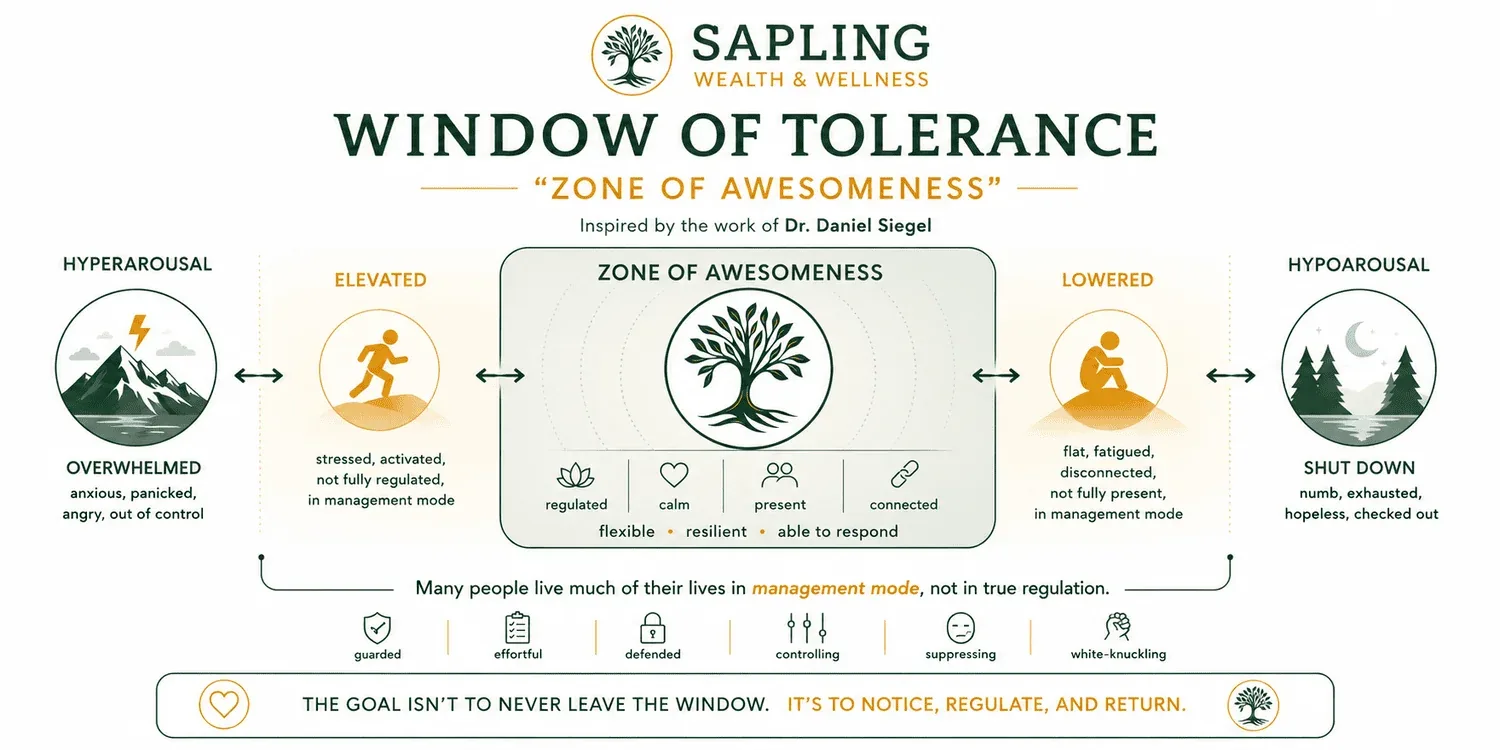
If we want to make deeply aligned decisions, we must first regulate our nervous systems to the point where we can be present in what is known as our Window of Tolerance. Dr. Daniel Siegel introduced this concept to describe the optimal zone of arousal within which individuals can function most effectively — emotionally regulated, cognitively flexible, curious, and socially engaged. Within this window, reflection, integration, and thoughtful decision-making become possible. Outside that window, the nervous system shifts toward survival responses: fight, flight, freeze, fawn, or compulsive control. Chronic adversity may narrow this regulatory window over time, making overwhelm more easily activated and more difficult to recover from.
In his clinical work, Cameron Wharram (RCC) occasionally has the opportunity to go just a little bit further with clients, helping them find their Zone of Awesomeness (ZOA). This term comes from practice-based evidence — learning directly from what has worked for hundreds of clients. As the name sounds, the Zone of Awesomeness is our sweet spot, where we are not just regulated, but also able to observe and learn from both our emotional responses and our intellectual wisdom. Clients describe this state as feeling present, curious, and full of clarity.
As a financial coach, this distinction is important to me. My role is not to do deep trauma processing, but rather to recognize when overwhelm and nervous system patterns may be influencing my clients’ financial behaviour, help them build awareness and capacity within the scope of our relationship, and refer out when deeper therapeutic work is appropriate.
Understanding where your window currently sits is important — not as a judgment, but as a starting point. Because once we begin recognizing what regulation actually feels like, we can gradually expand that capacity. Instead of repeatedly cycling through overwhelm, shame, and perceived failure, we begin building new experiences of safety, regulation, and resilience. In fact, simply practicing naming how we are presently feeling, and where we are on the spectrum of hyper to hypo-arousal, strengthens the part of our brain that helps us spend more time in our Zone of Awesomeness.
This is also where client agency becomes central. The goal of this work is not to create long-term dependency on a financial planner or therapist. It is to help clients rehearse regulation often enough that they begin rebuilding safety from the inside out — making their own grounded decisions, not because someone told them to, but because they are gradually becoming people who trust themselves to do so. Importantly, the brain remains plastic throughout life. Nervous systems retain the capacity for healing, integration, and change across a person’s lifespan. With time, awareness, supportive relationships, and yes, a little grace for both ourselves and the people who came before us, new patterns can gradually emerge.
If you would like to try a practical nervous system regulation exercise Cameron recommends, you can find it in the Toolkit section at the end of this article.
Deeper Connection and Meaning-Making
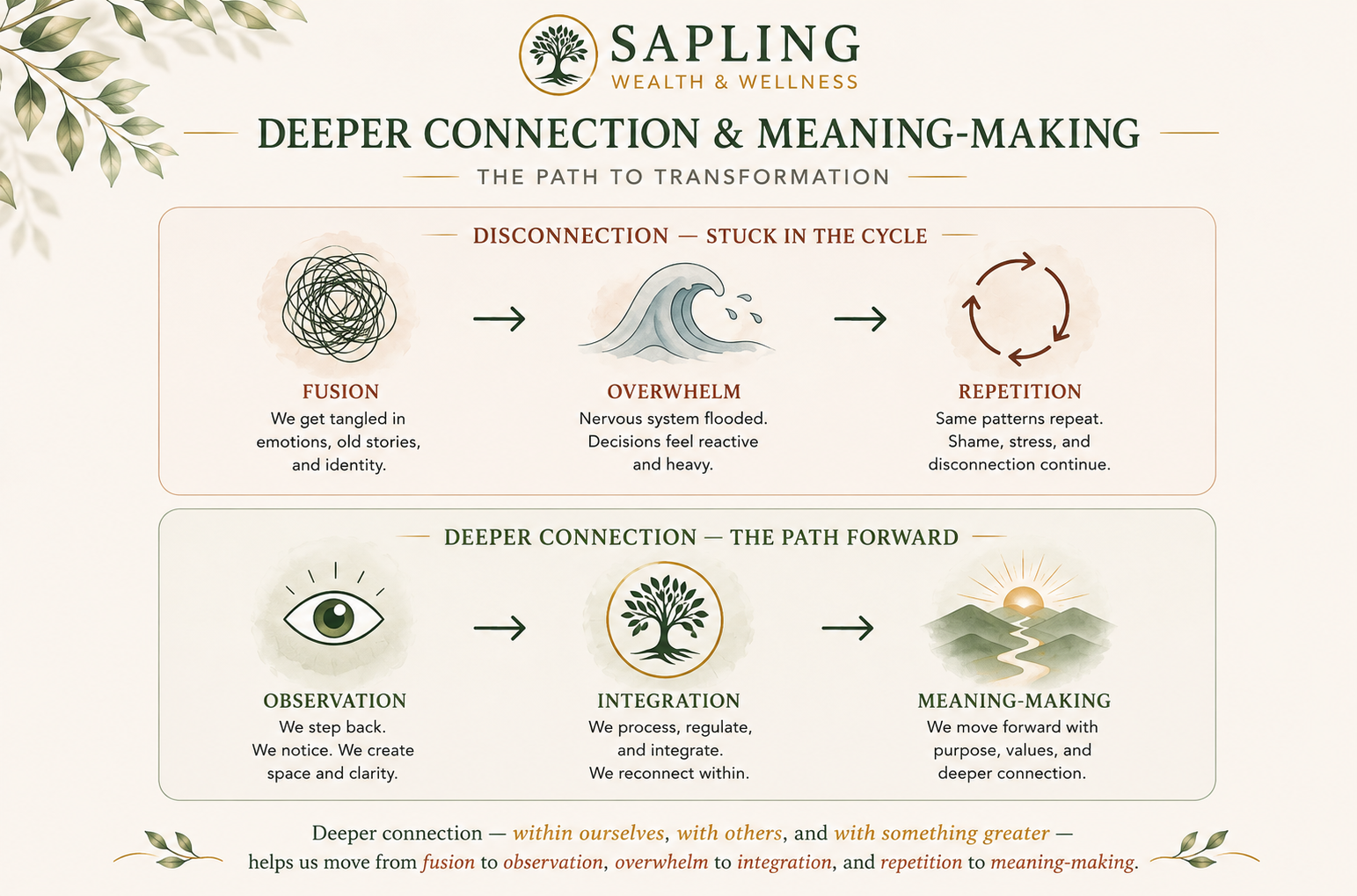
This is where deeper connection becomes deeply important (refer to my last blog for more).
As I explored in the last blog, vertical connection can deepen our access to Self, presence, and a sense of something larger than ourselves, while the relationship between Self and our parts can also be understood as horizontal. The two are not necessarily separate; they can work together in a kind of loop, with inner connection supporting greater access to presence and meaning, which in turn can deepen our connection to ourselves and others.
In Internal Family Systems (IFS), developed by Dr. Richard Schwartz, the Self is often described through qualities known as the Eight C’s: calmness, curiosity, compassion, clarity, confidence, courage, creativity, and connectedness. These qualities can shape both dimensions of connection: vertically, through a deeper sense of presence and connection to something greater, and horizontally, through the way Self relates to our parts and to other people. If you are curious, you can read more about IFS here, and I will also explore it further in the next article as we begin discussing practical pathways toward healing, regulation, and integration.
Here is something worth pausing on:
Research suggests that meditation and mindfulness practices can induce neuroplasticity, increase cortical thickness, reduce amygdala reactivity, and improve brain connectivity, leading to improved emotional regulation, cognitive function, and stress resilience. Prayer, stillness, reflection, and contemplative practice appear to work through similar pathways.
In other words, the very regions of the brain that may have been shaped by early adverse experience appear to be among the regions most responsive to these practices later in life.
But this deeper sense of connection is not a permanent state one achieves and maintains indefinitely. Human life does not work that way. To be human is to experience rupture, uncertainty, grief, overwhelm, loss, and disorientation repeatedly. Yet alongside suffering also exists joy, awe, beauty, creativity, love, laughter, wonder, community, meaning, and moments of profound connection that remind us why life is worth participating in so fully.
Perhaps this deeper connection is less about transcending suffering and more about maintaining orientation toward meaning through all of it, remaining open not only to pain, but also to beauty, purpose, gratitude, and the possibility of renewal even after difficult seasons. As we begin to understand our money stories, we gain the opportunity to rewrite patterns that once felt permanent.
Over time, suffering that is reflected upon rather than endlessly repeated can begin transforming into wisdom. We begin asking different questions. Not simply, “Why did this happen to me?” but also: “What did this teach me? What strength or compassion emerged through it?” Difficult experiences do not disappear, but they can gradually become integrated into a larger story rather than remaining unresolved sources of shame or fragmentation.
One of the most profound insights I have experienced came during a deeply reflective meditation, at a time when I was carrying an intense fear of making mistakes. The years leading up to that moment had been deeply inward ones: revisiting painful memories, reconnecting with younger parts of myself, slowly learning how to offer compassion to experiences I had suppressed for decades.
During the meditation, I was given an image that has stayed with me ever since. I saw myself being handed the keys to my garden. I remember feeling afraid — uncertain whether I could trust myself to plant wisely after so many seasons of feeling lost. But the message that emerged was simple: the garden had already been cultivated. The weeds had been pulled. The ground was ready.
The soil is fertile. And it is okay to fear — but wrap it up with hope.
Later, I could not help but think about Frances Hodgson Burnett’s The Secret Garden, a story written in 1911 that seemed to understand all of this intuitively. At its heart, it is a story about what begins to happen when safety, care, and relationship slowly return to a wounded inner world. Healing often feels exactly like that. Not becoming someone entirely new, but slowly bringing life back to parts of ourselves that were forced into survival for too long.
From that more grounded place, horizontal connection — both within ourselves and with the people around us — becomes easier, too. As trust develops between Self and our parts, and the nervous system no longer experiences the world primarily through the lens of survival, others begin feeling less like threats and more like fellow human beings carrying their own fears, wounds, hopes, and stories. Trust, vulnerability, and genuine connection become more accessible.
What This Means for Financial Planning
Financial planning is ultimately about human beings navigating uncertainty, meaning, responsibility, fear, hope, identity, relationships, and survival within increasingly complex systems. Numbers matter enormously. But the nervous systems and money stories beneath those numbers matter too.
Understanding these emotional and biological layers does not replace technical planning. It creates the conditions where people feel safe enough to reflect honestly, remain present with uncertainty, and begin making more intentional decisions over time.
Because ultimately, enough was never simply a financial equation.
It has always been relational.
I also recognize that some readers may feel deeply stuck in patterns that seem difficult to shift alone. I understand that feeling personally. Healing is rarely linear, and different people may require different forms of support, reflection, community, or therapeutic work depending on their experiences and circumstances.
In the next article, I will explore some of the practical ways people begin expanding their capacity for regulation, connection, and meaning-making — including approaches that helped me personally as I moved through my own healing journey.
With love, gratitude and compassion,
Olena
Sapling Wealth & Wellness
Where wealth meets meaning.
TOOLKIT: A Practical Regulation Exercise
The following exercise was contributed by Cameron Wharram (RCC), who works more deeply with clients in the area of nervous system regulation and emotional processing.
If you’re willing, I’d like to invite you to practice a brief exercise to see if you can inch a little closer to your Zone of Awesomeness. It will take about 3-4 minutes:
When you’re ready, take a few moments to simply notice your body and connect with your breath. Take 3 deep exhales.
Now ask yourself, how overwhelmed or shut down do I feel, right now?
– – – allow a few moments for an answer to arise – – –
How did you know how to answer that question? What did you observe in your mind and body? Tightness or emptiness in your chest, belly, or throat? A calm mind, or racing thoughts? Did you notice any intense urges to move? Maybe your day’s to-do list flashed through your mind? Or, maybe you almost fell asleep?
If you noticed any unsettling emotions, physical sensations, or thoughts, I encourage you to redirect your breath, precisely to where you notice anything that’s unsettled. As best as you can, imagine lovingly drenching that feeling with your breath.
The goal isn’t to make any feelings go away, just the opposite, the goal is to be present, without judgment.
If you are still in overdrive, try to keep directing your breath towards whatever you notice is overwhelmed, and try to really slow down your breathing, especially your exhale. Inhale normally, and try to extend your exhale for at least 6 seconds.
If you’re tired and struggling not to shut down, try to increase the pace of your breathing, just a little bit. Exhale as your normally would, but increase the pace and intensity of your inhales.
After about two minutes, allow your breath to simply return to normal, and notice the sensations in your fingers and toes. Hopefully, you also notice that you’ve started to feel…. Just a bit more awesome!
If this exercise was helpful for you, I encourage you to practice frequently, especially before making any important decisions, or engaging in any difficult conversations.
References: For those who are curious
Attachment
Wilhelm, K., Gillis, I., & Parker, G. (2016). Parental bonding and adult attachment style: The relationship between four category models. International Journal of Women’s Health and Wellness, 2, 016.
Marian J. Bakermans-Kranenburg, Or Dagan, Rodrigo A. Cárcamo & Marinus H. van IJzendoorn (2025). Celebrating more than 26,000 adult attachment interviews: mapping the main adult attachment classifications on personal, social, and clinical status, Attachment & Human Development, 27:2, 191-228.
Neuroscience
Schore, A. N. (2015). Affect regulation and the origin of the self: The neurobiology of emotional development. Routledge.
Figner, B., Knoch, D., Johnson, E. J., Krosch, A. R., Lisanby, S. H., Fehr, E., & Weber, E. U. (2010). Lateral prefrontal cortex and self-control in intertemporal choice. Nature Neuroscience, 13(5), 538–539.
Kolk, S. M., & Rakic, P. (2022). Development of the prefrontal cortex. Neuropsychopharmacology, 47(1), 41–57.
McLaughlin, K. A., Sheridan, M. A., & Lambert, H. K. (2019). Childhood adversity and neural development: A systematic review. Annual Review of Developmental Psychology, 1(1), 277–312.
Merrick, M. T., Ford, D. C., Ports, K. A., Guinn, A. S., Chen, J., Klevens, J., Metzler, M., Jones, C. M., Simon, T. R., Daniel, V. M., Ottley, P., Barnett, S. B., & Mercy, J. A. (2019). Vital signs: Estimated proportion of adult health problems attributable to adverse childhood experiences and implications for prevention—25 states, 2015–2017. Morbidity and Mortality Weekly Report, 68(44), 999–1005.
Teicher, M. H., Dumont, N. L., Ito, Y., Vaituzis, C., Giedd, J. N., & Andersen, S. L. (2004). Childhood neglect is associated with reduced corpus callosum area. Biological psychiatry, 56(2), 80–85.
Money Scripts
Klontz, B., Britt, S. L., Mentzer, J., & Klontz, T. (2011). Money Beliefs and Financial Behaviors: Development of the Klontz Money Script Inventory. Journal of Financial Therapy, 2(1) 1.
Adverse Childhood Experiences
American Psychological Association. (2023, November). Stress in America 2023: A nation recovering from collective trauma.
Bergman N. J. (2019). Birth practices: Maternal-neonate separation as a source of toxic stress. Birth defects research, 111(15), 1087–1109.
Cronholm, P. F., Forke, C. M., Wade, R., Bair-Merritt, M. H., Davis, M., Harkins-Schwarz, M., Pachter, L. M. & Fein, J. A. (2015). Adverse childhood experiences: Expanding the concept of adversity. American Journal of Preventive Medicine, 49(3), 354–361.
Felitti, V. J., Anda, R. F., Nordenberg, D., Williamson, D. F., Spitz, A. M., Edwards, V., Koss, M. P., & Marks, J. S. (1998). Relationship of childhood abuse and household dysfunction to many of the leading causes of death in adults: The adverse childhood experiences (ACE) study. American Journal of Preventive Medicine, 14(4), 245–258.
Finkelhor, D., Shattuck, A., Turner, H., & Hamby, S. (2013). Improving the adverse childhood experiences study scale. JAMA Pediatrics, 167(1), 70–75.
Hughes, K., Bellis, M. A., Hardcastle, K. A., Sethi, D., Butchart, A., Mikton, C., Jones, L., & Dunne, M. P. (2017). The effect of multiple adverse childhood experiences on health: A systematic review and meta-analysis. The Lancet Public Health, 2(8), e356–e366.
Lee, H., Kim, Y., & Terry, J. (2020). Adverse childhood experiences (ACEs) on mental disorders in young adulthood: Latent classes and community violence exposure. Preventive Medicine, 134, Article 106039.
McEwen, B. S. (2012). Brain on stress: How the social environment gets under the skin. Proceedings of the National Academy of Sciences – PNAS, 109(Supplement 2), 17180–17185.
Shonkoff, J. P., Garner, A. S., Siegel, B. S., Dobbins, M. I., Earls, M. F., McGuinn, L., Pascoe, J., Wood, D. L., High, P. C., Donoghue, E., Fussell, J. J., Gleason, M. M., Jaudes, P. K., Jones, V. F., Rubin, D. M., Schulte, E. E., Macias, M. M., Bridgemohan, C., Goldson, E., … Wegner, L. M. (2012). The lifelong effects of early childhood adversity and toxic stress. Pediatrics (Evanston), 129(1), e232–e246.
Hair, N. L., Hanson, J. L., Wolfe, B. L., & Pollak, S. D. (2015). Association of child poverty, brain development, and academic achievement. JAMA Pediatrics, 169(9), 822–829.
Hanson, J. L., Adluru, N., Chung, M. K., Alexander, A. L., Davidson, R. J., & Pollak, S. D. (2013). Early neglect is associated with alterations in white matter integrity and cognitive functioning. Child Development, 84(5), 1566–1578.
Hanson, J. L., Hair, N., Shen, D. G., Shi, F., Gilmore, J. H., Wolfe, B. L., & Pollak, S. D. (2013). Family poverty affects the rate of human infant brain growth. PLOS ONE, 8(12), e80954.
Herringa, R. J., Birn, R. M., Ruttle, P. L., Burghy, C. A., Stodola, D. E., Davidson, R. J., & Essex, M. J. (2013). Childhood maltreatment is associated with altered fear circuitry and increased internalizing symptoms by late adolescence. Proceedings of the National Academy of Sciences, 110(47), 19119–19124.
Wolff, K. T., Baglivio, M. T., & Piquero, A. R. (2018). The protective impact of ACEs screening and trauma-informed care: A systematic review. Journal of Child and Adolescent Trauma, 11(4), 425–440.
Wade, R., Cronholm, P. F., Fein, J. A., Forke, C. M., Davis, M. B., Harkins-Schwarz, M., Pachter L. M., & Bair-Merritt, M. H. (2016). Household and community-level adversity and toxic stress. Academic Pediatrics, 16(3), 165–172.
Positive Psychology, Prayer and Meditation
Fredrickson, B. L. (2001). The role of positive emotions in positive psychology: The broadenand- build theory of positive emotions: The broaden-and-bulild theory of positive emotions. American Psychologist, 56(3), 218–226.
Lally, P., van Jaarsveld, C. H. M., Potts, H. W. W., & Wardle, J. (2010). How are habits formed: Modelling habit formation in the real world. European Journal of Social Psychology, 40(6), 998–1009.
Danielson, M. L., Claussen, A. H., Bitsko, R. H., Katz, S. M., Newsome, K., Blumberg, S. J.,Kogan, M. D., & Ghandour, R. (2024). ADHD Prevalence Among U.S. Children and Adolescents in 2022: Diagnosis, Severity, Co-Occurring Disorders, and Treatment. Journal of clinical child and adolescent psychology : the official journal for the Society of Clinical Child and Adolescent Psychology, American Psychological Association, Division 53, 53(3), 343–360.
Davidson, R. J., & McEwen, B. S. (2012). Social influences on neuroplasticity: Stress and interventions to promote well-being. Nature Neuroscience, 15(5), 689–695.
Deci, E. L., & Ryan, R. M. (2000). The “what” and “why” of goal pursuits: Human needs and the self-determination of behavior. Psychological Inquiry, 11(4), 227–268.
Calderone, A., Latella, D., Impellizzeri, F., de Pasquale, P., Famà, F., Quartarone, A., & Calabrò, R. S. (2024). Neurobiological Changes Induced by Mindfulness and Meditation: A Systematic Review. Biomedicines, 12(11), 2613.
Haverkamp, E., Olsman, E., Ćurčić-Blake, B., Vila Ramírez, V., Aleman, A., Ket, J. C. F., & Schaap-Jonker, H. (2025). The convergent neuroscience of Christian prayer and attachment relationships in the context of mental health: a systematic review. Frontiers in psychology, 16, 1569514.


